The Record vs. The Work
Table of Contents
The Record vs. The Work
Author’s Note
This post is the first in a two-part series written from the worker side of the labor process. The second, "The Exit," documents what happened when management recognized the counter-archive and opened an extraction window. Together they show how discipline is produced through documentation, how workers build counter-records to survive, and what it looks like to exit on your own terms. Examples are bounded to direct observations and artifacts. The aim is not an exit interview or a morality play; it's a worker record built to preserve lessons that turnover is structured to erase.
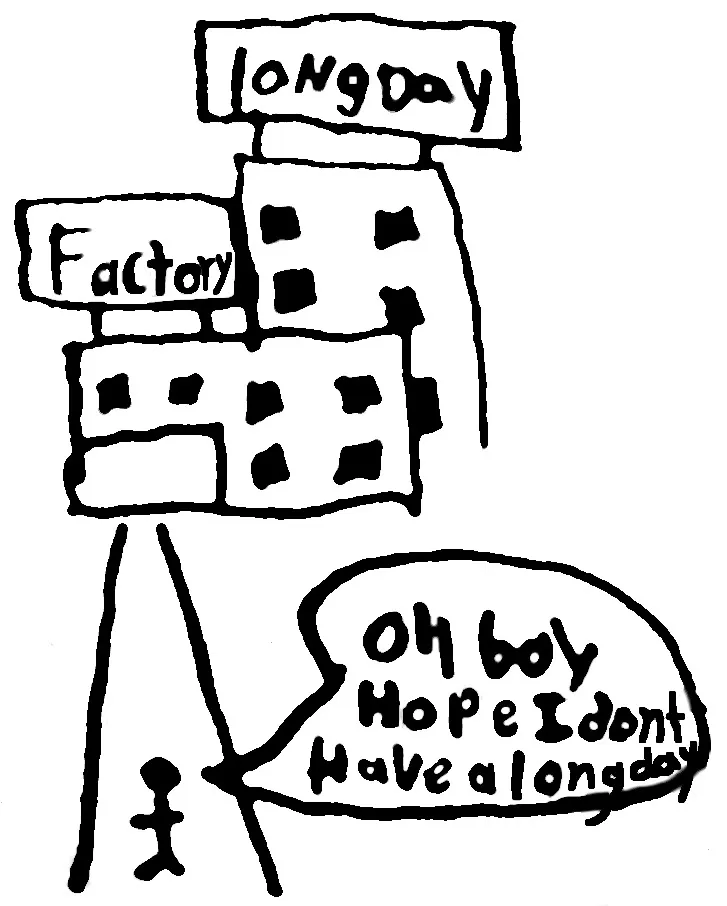
Cartoon left on-site, drawn on a box of toilet paper: a “long day factory,” with a stick figure saying “oh boy hope I don’t have a long day.”
The Job Posting vs. the Job
I worked as a night-shift janitor for a contracted cleaning crew servicing a large industrial client site in Spokane. The job posting made it sound like basic cleaning work: taking out trash, wiping down bathrooms, sweeping floors, tidying break rooms, keeping the place looking neat, and checking in with a supervisor.
But the actual job was nothing like that.
Cleaning inside a locked industrial facility meant working under continuous monitoring potential and periodic human intervention. Keys and badges controlled movement. Supplies ran low. Many restrooms could only be serviced during short posted closure windows. And output wasn’t judged only by whether the space was actually clean, it was judged by whether the work was legible to supervision through logs, sightings, timestamps, and paper “standards” that can be rewritten after the fact.
The Rule
I didn’t plan to become a note-taker at work. I planned to clean restrooms, hit the Kaivac windows, restock, and go home. Then the job taught me its real rule:
If something becomes reportably visible, the record activates.
If it is reportable, it is disciplinable. Once an event crosses a documentation threshold, your personal discretion as a worker collapses and the administrative machinery takes over. If you can’t make the work legible on your terms, it will be rewritten against you. Even time itself is policed this way, punches are geofenced and exceptions become formal requests, so the paper record can override the lived shift if you fail to submit the right form on the right clock.
A Specimen From the Log
To see how these mechanisms manifest on the page, look at the communications log itself, not just a single line, but the surface as a designed tool with explicit rules about how it should be used.
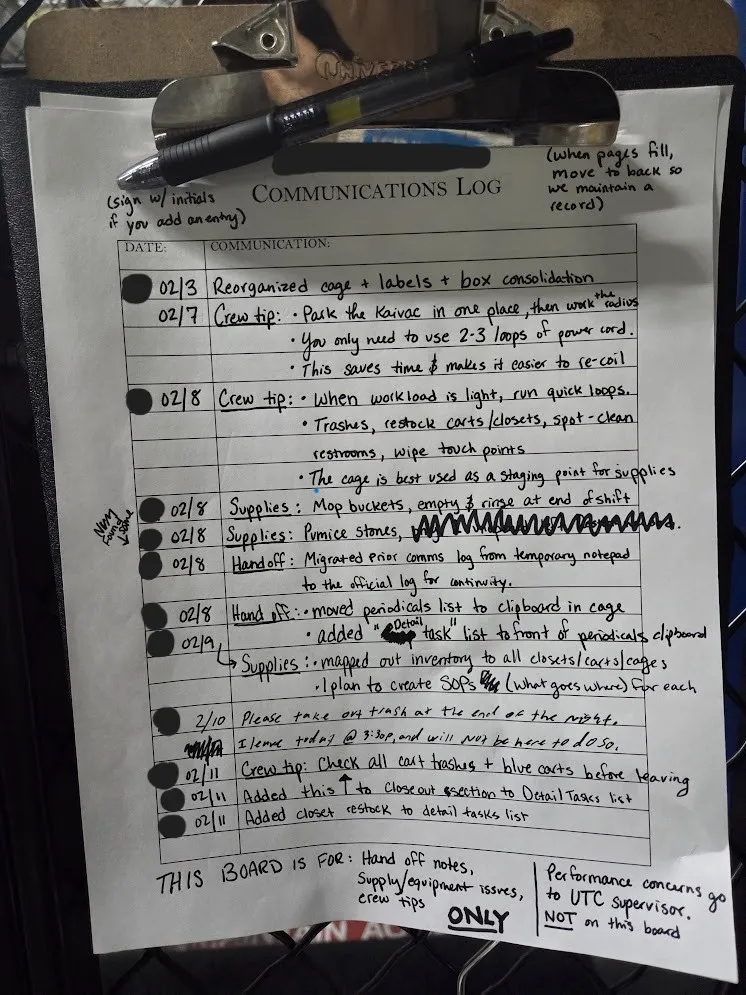
This log didn't originate from management. The Night Area Supervisor had given the crew official log sheets weeks earlier; I found them, formalized the log by hanging it in the supply cage, and coordinated with the site supervisor to make it useful for cross-shift handoffs. That's why my handwriting dominates the page. I started using it as a tool on 01/28, and for a while the only other person consistently acclimated to its function was the site supervisor.
Structurally, the log is built to reproduce the labor process across a shift gap. It demands legibility (date + entry), attribution (initials), and retention (when the page fills, move it to the back “so we maintain a record”). It also tries to constrain scope by claiming that the board is for handoff notes, supply/equipment issues, and crew tips, while “performance concerns” are supposed to route to supervision rather than be litigated in public.
Inside that structure you can see the intended functions in practice: operational continuity (handoff items and migrated notes), technical standardization (crew tips about Kaivac staging and cord loops), inventory reality (supply notes), and closeout routines. You can also see how easily neutral continuity becomes enforceable obligation. A line like “Please take out trash at the end of the night” is functionally a handoff directive, but once it exists as a dated, initialed artifact, it can be reread later as an assignment with a compliance status.
Weeks later, nobody remembers the shift context; the line remains, and it can be reread as a missed assignment rather than a handoff note.
That double character is the point. In the best case, shared documentation reproduces the labor process by carrying concrete context forward. In the failure case, the same surface becomes a venue for sideways discipline (indirect demands, insinuation, and “accountability” language aimed at coworkers rather than routed through supervision), creating conflict while still feeding the record.
Here is that failure-case demonstrated in the same medium:

“Don’t leave trash in anything!!!!!” (02/07)

“Pro tip: standing in the cage for hours on end is not working.” (02/08)
These are not handoff notes. They don’t name a specific location, condition, constraint, or next action in a way that helps the next shift produce output. They read as enforcement: a scolding tone, a generalized accusation (“standing… for hours,” “trash in anything”), and a unilateral attempt to set behavioral standards sideways through the shared record, precisely the use that the log’s own boundary condition is supposed to prevent (performance concerns routed to supervision, not performed on the board).
Once it is used to police peers, it manufactures “reportable visibility” by creating an artifact that invites interpretation, blame, and escalation, without the writer having to own a direct conversation or a formal supervisory route.
Base and Superstructure
To understand the friction of this site, you have to look past the personalities and into the relationship between the material base and the disciplinary superstructure.
The base is the labor process itself. It consists of the hard, physical constraints of the floor: the narrow time windows where a restroom is actually accessible, the equipment and supply shortages, the staffing levels, the messy handoffs between shifts, and the objective time it takes to produce a "ready" restroom. This is the reality of the work as it is performed in space and time.
The superstructure is the regime that governs that base. It is the administrative apparatus of management layers, HR, client oversight, and surveillance. This is where the work is translated into a moral vocabulary of "ownership" and "professionalism" to make discipline sound natural. This superstructure operates through logs, standards language, and escalation pathways designed to monitor compliance from a distance.
The conflict between these two layers defines the daily experience of the shift. When the material base is strained, the system rarely responds by redesigning the process or paying for more capacity. Instead, it responds by intensifying the record. Faced with a choice between fixing the underlying problem and perfecting the paperwork, management consistently chooses the latter, treating the documentation as a substitute for a solution. This site resolves base strain by intensifying legibility and punishment, not capacity. Here, the record is transformed from a tool to allocate resources into a tool to allocate blame.
One night the base was strained in the most ordinary way: we ran out of basic consumables in the supply cage and the posted plan assumed full restocks. There was no material fix available at 11:00pm, no access to ordering, no approved substitute, no spare stock. The superstructure response was not “adjust the plan” or “resource the cage.” It was “account for it.” Convert the shortage into a dated, attributable artifact and preserve a story that could travel upward. That was the documentation threshold, once the shortage had to be written down as a formal entry with initials (or routed as a message to supervision), it stopped being a material constraint and became a compliance object with an implied responsible party. The shortage became a compliance problem. The work became narrative triage. That’s why the supply cage and comms log are not neutral tools, they are where shortages are translated into responsibility.
The Control System
Once you see the record as the site's enforcement medium, the recurring patterns stop looking like random management quirks and start revealing their underlying logic. To survive the shift, you have to understand the site as a control system, not a commonsense cleaning job. A small set of mechanisms repeats, predictably, across incidents.
The site disciplines through legibility-first visibility: what matters is not what happened, but what becomes reportably visible as a readable artifact (a log line, a photo, a complaint, a timestamp). That visibility can be direct (someone sees it) or deferred (someone reads it later), but the effect is the same, the record activates enforcement.
The work also runs on two schedules (the posted plan and the real labor process) which produces dead zones that workers have to bridge with plausibility labor: explaining, pre-empting, and documenting why the official schedule could not be made real on the floor.
Then there are documentation thresholds that terminalize minor frictions. The threshold isn’t “how bad it was,” it’s the form: a write-up, an ops/HR email, a client complaint, a photo forwarded upward, a log entry reframed as “refusal” or “noncompliance.” Once the incident crosses into that format, lateral problem-solving collapses and the task becomes narrative survival.
Finally, there is the authority cutoff: once operations becomes involved, local discretion collapses. The room for nuance disappears because the issue is no longer being handled as work; it’s being handled as a record.
These mechanisms chain: visibility produces artifacts; artifacts cross thresholds; thresholds trigger authority cutoff.
Individual Survival: The Counter-Archive
To survive this environment, I had to build my own infrastructure. What I created was a counter-archive, a collection of field notes, hand-drawn maps of the facility’s "dead zones," profiles of how different supervisors reacted to specific triggers, and my own set of SOPs and protocols. I maintained a communication log that tracked the actual flow of supplies and shift handoffs. These were the blueprints of a hidden reality. This is worker-side infrastructure.
I built this because official documentation is designed to answer only one question: "Who can we hold responsible when something becomes reportably visible?" My documentation answered the questions the system ignored. What actually happened on the floor? What material constraints made it happen? What patterns are repeating because the system itself reproduces them?
Counter-archives are a survival technology because industrial workplaces are often designed to forget on purpose. High turnover is a primary feature of being subjected to a contract you have no say in, not a bug, and institutional memory is treated as an obstacle to be cleared away. Management often prefers a fresh worker who doesn’t know the history to a veteran who can name the contradictions. By documenting the labor process, I created a record that blocks that structural amnesia, making the job harder to mythologize and protecting the next person from being gaslit by a paper reality.
I timed the Kaivac windows because the posted schedule is a suggestion, not a law of nature. I tracked "escalation latency" because discipline travels through specific channels and predictable delays. I photographed the supply cage and the comms board because inventory becomes political when your output depends entirely on what you can actually access. I learned the surveillance and geofencing rules because the work is being judged by proxies, and those proxies are what decide who gets blamed.
Collective Survival: Solidarity Across the Shift Gap
Because the chain runs through artifacts and thresholds, workers survive by controlling how breakdowns enter the record and by sharing local knowledge the map deletes.
On paper, workplaces run on rules; in reality, they run on the quiet infrastructure of horizontal relationships. This creates a fundamental contradiction for the company: they need our cooperation to actually produce output, but they need our atomization to maintain control. Management tends to view any coordination they don't oversee as a threat, because when workers talk to each other, management loses its monopoly on the narrative.
These alliances are how workers navigate the "dead zones" between the official schedule and the floor, resisting the narrative capture that management uses to individualize failure. Whether it's a heads-up about a broken badge reader or a tip on how to avoid a specific supervisor's "standards" trap, these quiet forms of solidarity are the foundation organizing grows from. They are the only way to survive a system that tries to prevent us from ever standing on the same map.
I remember a specific relay. A passive-aggressive note appeared on the shared board, positioned to become a reportable visibility event. Instead of responding publicly, a trust channel opened: a short message from the other side of the shift gap, what the note was trying to do, what constraint actually caused the miss, what would keep it from crossing a documentation threshold. That message changed the next action: we logged the constraint neutrally, fixed the material issue, and starved the note of the escalation story it needed.
Theoretical Justification: Organizers and Legibility
Every class needs its own organizers and thinkers. Gramsci called the worker who does that from inside the labor process the “organic intellectual.” On my janitorial night shift, this was concrete practice.
By the end, I understood the labor process better than my supervisors did. That's the indictment: authority here doesn't require understanding the work. It requires controlling the record that defines whether the worker is "in compliance."
In organized shops, this function is partially formalized: stewards, safety reps, grievance handlers, rank-and-file caucuses, shop papers. In unorganized, contract-fragmented shops, it appears informally because the need doesn’t disappear, someone still has to translate the labor process into a worker-usable record where shifts don’t overlap and management controls the official channels.
Political scientist James C. Scott argues in Seeing Like a State that large institutions rule by making complex realities “legible.” They simplify messy, local practices into standardized categories that can be measured, compared, and administered from a distance. On this site the categories were things like ‘Kaivac done,’ ‘restroom ready,’ ‘trash out,’ ‘stocked,’ ‘checked,’ and ‘logged,’ boxes that ignore access choke points and supply bottlenecks until the miss becomes visible. That simplification isn’t neutral. It’s what makes intervention possible: you can only manage what you can count, audit, and file. Scott’s other point matters more here, interventions routinely misfire because the simplification deletes the local knowledge that made the practice work in the first place. The institution acts as if the map is the territory. When reality refuses the map, the institution doesn’t conclude “the map was wrong.” It concludes “the people on the ground failed.”
That is the logic of legibility-first discipline on this site. “Standards” fail on the floor because they are administrative ghosts of the work: checklists, time windows, compliance language. Everything that doesn’t fit the categories (access choke points, cross-shift dependencies, supply bottlenecks, the actual minutes required) gets treated as irrelevant until it produces a visible miss. Then the superstructure intervenes using the simplified record.
My counter-archive is a worker-side reversal of that process. It restores what the administrative map deletes so workers can predict where interventions will fail, where blame will be allocated, and how to keep a predictable breakdown from being rewritten as personal defect.
What Comes Next
The next piece, "The Exit," documents what happened when management recognized the counter-archive existed and opened an extraction window to seize it. It shows the full sequence: format control, retention theater, weaponized compliance, tactical solidarity, and four-channel distribution. The mechanisms traced here, (documentation thresholds, authority cutoff, legibility-first discipline) are what management deployed. The counter-archive is what made the response possible.
Closing: The Takeaway
The stable takeaway is the chain: reportable visibility produces artifacts; artifacts cross thresholds; thresholds trigger authority cutoff; authority cutoff replaces work with record management.
This series isn’t a reflection on one night shift. It’s a six month account of contract work under a documentation-and-surveillance regime that shows how the map replaces the territory, how predictable breakdowns get reclassified as personal failure, and how workers build counter-records to survive.
I chose to build.
By documenting the friction, the dead zones, and the material constraints, I reclaimed the right to define my own labor and built a counter-archive to ensure the intelligence of the worker isn't treated as noise. It's where the job actually lives: in the handoff notes, the Kaivac windows, the supply cage, and the time management's schedule doesn't account for.